



Other Languages
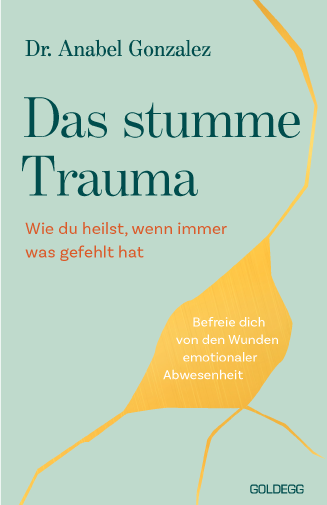
Das stumme Trauma
Anabel Gonzalez (2026)
Innere Unruhe, Überforderung, das Gefühl einfach „nicht richtig“ zu sein: Das sind Merkmale stummer Traumata. Verletzungen, an die es nur leise Erinnerung gibt und die dennoch kräftig in uns weiterwirken. Denn das Ungesagte und die Leere hinterlassen oft tiefere Wunden als ein Schlag oder eine Beleidigung.
Anabel Gonzales gibt dem Unsagbarem einen Rahmen und zeigt uns wie wir unsere emotionale Sprachlosigkeit hinter uns lassen können.
Mit achtsamer Selbstbeobachtung finden wir zurück zu unseren Gefühlen und befreien uns von den stillen Lasten der Vergangenheit.


疤痕不疼
Anabel Gonzalez (2025)

隐性创伤的情绪地雷
Anabel Gonzalez (2025)
为何经常觉得自己不够好,不被疼爱?
为何习惯用暴饮暴食来消除烦恼?
为何你的情绪经常失控、易怒?
如何让过去的伤痛不影响当下幸福?
如何重建健康的依恋关系?
……

别让恐惧主宰了生活
Anabel Gonzalez (2025)

La cosa bella di avere una brutta giornata
Anabel Gonzalez (2021)

Quello che non è successo
Anabel Gonzalez (2026)

EMDR ed elaborazione emotiva: Lavorando con pazienti con grave disregolazione
Anabel Gonzalez (2021)

安娜贝尔·冈萨雷斯
Anabel Gonzalez (2022)

To (nie) ja.
Anabel Gonzalez (2023)

O que nunca foi
Anabel Gonzalez (2026)
Palavras que não foram ditas, momentos em que não nos sentimos reconhecidos pelas pessoas que mais importam para nós podem ser mais dolorosos do que um golpe ou um insulto.
De que modo é que aquilo que não aconteceu influencia aquilo que acontece connosco agora?
Os efeitos desta vida não vivida são geralmente silenciosos, latentes e profundos.
Com base na sua experiência como psiquiatra especializada em trauma, a autora bestseller Anabel Gonzalez examina aqui diferentes cenários relacionados com tudo o que não aconteceu, mas que nos afeta ainda assim, e que pode ser a peça em falta do puzzle para que possamos realmente conhecer-nos a nós mesmos.

тебе повезло!
Anabel Gonzalez (2022)

Это не я!
Anabel Gonzalez (2023)

А можно я с тобой?
Anabel Gonzalez (2024)
Тревоги и паника мешают нам адекватно воспринимать происходящее и принимать взвешенные решения. Психолог Анабель Гонсалес подробно разбирает, что же такое страх и токсичные отношения, показывая различные ситуации и предлагая упражнения, чтобы справиться с ними.

壞情緒,變好事的5堂正向心理課
Anabel Gonzalez (2021)
突破困境的關鍵,不是時時保持樂觀,而是找出與壞情緒相處的方法,把爛事變好事!
負能量也沒關係,這是大腦在提醒你「多愛自己一點」,先與自己和解,就能讓壞情緒與你和平共處!
生活中的問題從沒少過,各種情緒也隨著大大小小的狀況被引爆。然而大多時候,我們都選擇了錯誤的應對,導致身心俱疲。想想看,你是不是也像這樣:
- 壓抑憂慮,不斷告訴自己「沒問題」
過度強調積極樂觀,反而使人試圖壓抑憂鬱,成為背景運作的APP,造成頭痛、失眠、記憶衰退,直到某天情緒爆發。 - 暴怒生氣,把問題都推給別人
問題通常沒能解決,還會在日後反覆發生,同時也會造成肌肉緊繃、疼痛。 - 自責羞愧,以為自己就是問題中心
無法將憤怒歸咎於他人,只好轉而譴責自己,如此一來,情緒將越陷越深,使身心機制免疫失調。

隱性創傷的情緒地雷
Anabel Gonzalez (2022)
你是否有以下狀況:
►易怒、玻璃心?
►經常會覺得自己不夠好、不被疼愛?
►習慣靠暴飲暴食忘卻煩惱?
其實,這些事的根本原因,都來自過往創傷,導致「情緒調節」出了問題!不是只有遭逢巨變才叫創傷,所有只要覺得不舒服,且對你有長遠負面影響的,無論大小,都可算是。因此,想擺脫創傷往事,重新活出自我,就必須先理解創傷來由。俄羅斯文學巨擘亞歷山大.索忍尼辛(Aleksandr Solzhenitsyn)曾說:「一個人若不瞭解自己的過去,就只能不斷重複相同的錯誤、犧牲與荒唐。」

Jak nie tłumić emocji
Anabel Gonzalez (2025)
Nieokazywanie emocji niesłusznie uchodzi za przejaw dojrzałości. Prawda jest taka, że kiedy masz naprawdę zły dzień lub przeżywasz kryzys, robienie dobrej miny do złej gry tylko wyczerpuje twoje i tak już ograniczone zasoby, a nieprzepracowane emocje wkrótce dają o sobie znać ze zdwojoną siłą. Rozwiązaniem jest regulacja emocjonalna, dzięki której przetrwanie trudnych chwil staje się łatwiejsze, a co więcej, zaczynasz dostrzegać w nim wartość i okazję do rozwoju. W tej książce Anabel Gonzalez, psychoterapeutka i autorka beststellera To (nie) ja, odsłania tajniki zdrowego i konstruktywnego zarządzania emocjami. Sięgnij po tę lekturę, by dowiedzieć się, jak:
- pozostawać w kontakcie ze swoimi emocjami,
- wyrażać smutek i złość, tak by nie zranić siebie ani innych,
- zyskać spokój potrzebny do podejmowania najlepszych decyzji,
- przestać wymagać od siebie zbyt wiele i zaopiekować się sobą w gorsze dni,
- skuteczniej kontrolować własne reakcje,
- wzmocnić odporność psychiczną,
- pogodzić się z samym sobą i osiągnąć trwałą równowagę emocjonalną.

To, co się nie wydarzyło
Anabel Gonzalez (2026)
Krzywdzi nas nie tylko to, czego doświadczyliśmy, lecz także to, czego nigdy nie było nam dane doznać.
Niewypowiedziane słowa, poczucie bycia nieważnym i niewysłuchanym, niespełnione nadzieje i obietnice, nieobecność tych, których najbardziej potrzebowaliśmy – te niewidzialne rany potrafią zadawać większy ból niż kłótnie, obelgi czy fizyczne ciosy. Łatwo je zbagatelizować, a jednak to właśnie ich wyleczenie stanowi niezbędny krok na drodze do spełnionego życia. Psychiatrka i psychoterapeutka Anabel Gonzalez w tej książce podpowie ci, jak to samodzielnie zrobić. Dowiesz się między innymi, jak:
odważyć się snuć plany i spełniać marzenia, nawet jeśli życie wielokrotnie cię zawiodło,
budować głębokie więzi i poczucie przynależności, nawet jeśli nieraz spotkałeś się z odrzuceniem,
ufać ludziom, nawet jeśli dawniej doświadczyłeś zdrady ze strony najbliższych,
żyć w szczerości i z pewnością siebie, nawet jeśli kiedyś byłeś zawstydzany i nieakceptowany,
skończyć z przemilczaniem ważnych tematów,
dać sobie pełne prawo do opowiadania własnej historii,
poczuć się kompletnym i wyjść z cienia przeszłości.
To, co się nie wydarzyło jest brakującym elementem układanki, który pozwoli ci naprawdę poznać samego siebie.

沒被接住的童年
Anabel Gonzalez (2026)

複雑性トラウマ・愛着・解離がわかる本
Anabel Gonzalez (2020)

No soc jo
Anabel Gonzalez (2026)
Els aspectes de la nostra personalitat que rebutgem ens expliquen una història molt important. La manera com definim qui som, la nostra identitat, es configura en base a les relacions significatives de la nostra vida. Quan en la nostra història hi ha hagut relacions complexes amb els nostres pares, parelles o figures significatives, pot canviar de manera molt profunda la manera com ens veiem a nosaltres mateixos. La nostra ment es fragmenta, i es genera al nostre interior un profund conflicte, que de vegades consumeix gran part de la nostra energia i que ens impedeix viure una vida plenament satisfactòria. En aquest llibre, orientat a pacients i familiars de persones que han patit situacions adverses encaixables en allò que s'anomena trauma complex, s'exposaran alguns dels problemes psicològics que aquestes situacions
poden generar. Basat en el treball amb pacients amb trauma i problemes d'aferrament, s'exposen diferents idees per superar els patrons posttraumàtics disfuncionals.
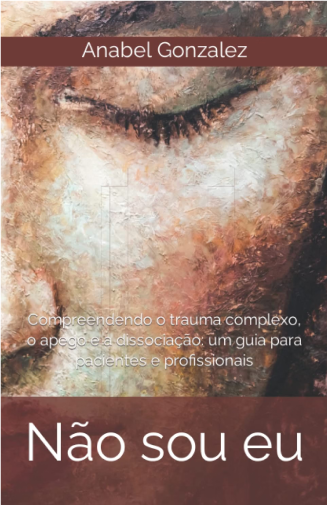
Não sou eu
Anabel Gonzalez (2022)
As consequências de catástrofes naturais ou acidentes podem ser graves, mas os traumas de tipo interpessoal são mais danosos e produzem transtornos mais profundos na identidade e crenças do indivíduo. Estes traumas interpessoais graves, em especial os que ocorrem nas primeiras etapas do desenvolvimento ou os que acontecem no seio das relações de confiança, dão lugar a quadros clínicos que foram englobados no conceito de trauma complexo.
Como animais sociais que somos, crescemos em grupos onde nos sentimos seguros e protegidos, continuando a fazer parte de redes de apoio na vida adulta. O mal que surge fora desses vínculos encontra-se dentro do espectável. Mas surgir por parte daqueles que esperamos que nos cuidem, que nos firam ou que nos ignorem, está fora da programação que a evolução tinha previsto para o nosso cérebro. Por isso, as histórias de maus-tratos ou abandono intra-familiar costumam originar traumas mais complexos.

Das bin ich nicht
Anabel Gonzalez (2018)
Die Aspekte unserer Persönlichkeit die wir ablehnen erzählen eine sehr wichtige Geschichte. Wer wir sind, unsere Identität, gestaltet sich ab den Interaktionen mit den bedeutenden Figuren unseres Lebens. Eine komplizierte Beziehung mit unseren Eltern, Partnern oder bedeutenden Figuren kann sehr stark beeinflussen wie wir uns selbst sehen. Unser Verstand teilt sich, entstehen tiefe Konflikte in uns die manchmal ein großer Teil unserer Energie verbrauchen und es ist uns unmöglich ein befriedigendes Leben zu führen. Dieses Buch basiert auf meine Arbeit mit Patienten mit Trauma und Bindungsschwierigkeiten und ist für Patienten und Familienangehörigen von Personen die widrigen Situationen, die man als komplexen Trauma bezeichnen könnte, durchlebt haben. Es werden verschieden Ideen über wie man dysfunktionale posttraumatischen Schemata verändern kann erläutert.
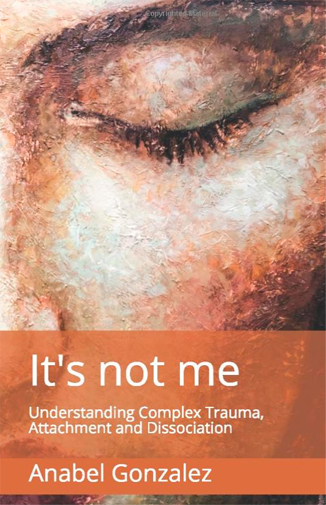
It's not me
Anabel Gonzalez (2018)
The aspects of our personality that we reject tell us a very important story. The way in which we define who we are - our identity - is shaped by the significant relationships in our life. If we have a history of complex relationships, whether it be with our parents, romantic partners or other significant figures, it can profoundly change the way we see ourselves.Our mind gets fragmented, and a deep conflict arises within us, which sometimes consumes a large part of our energy and keeps us from living a life that is fully satisfying. This book, which is aimed at patients and family members of people who have been through adverse situations that fit with what we call complex trauma, will present and explain some of the psychological problems that these situations can produce.Based on work done with patients who have a history of trauma or attachment disorders, different ideas are presented that can help overcome dysfunctional post-traumatic patterns.The aim of this book is to understand how the reactions that we have, which sometimes may be difficult even for us to explain, come from an accumulation of experiences and things we have learned, of which we may not even be fully aware. This book is about the psychological consequences of all these experiences, but mainly about our freedom to choose what we do with them.
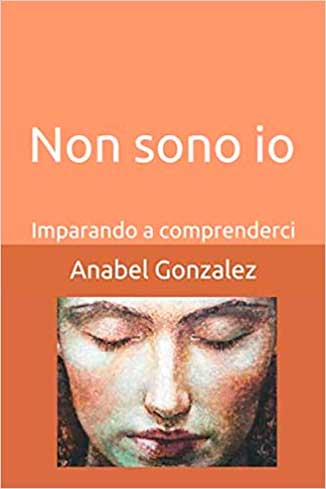
Non sono io
Anabel Gonzalez (2018)
In ognuna delle sue forme di presentazione è importante che si comprenda la relazione tra i problemi attuali e la storia al cui interno si generarono. Altrettanto fondamentale è capire perché, a dispetto che questi problemi ci causino malessere e angoscia, e che vogliamo modificarli, si mantengano invece nel tempo. Sono frequenti in persone che abbiano vissuto in un ambiente traumatico la sensazione di essere incompresi e la difficoltà per comprendere ciò che è loro toccato vivere. Da un lato è mancato loro il sentirsi guardato con l’accettazione incondizionata di cui ha bisogno ogni bambino; dall’altro il mondo intorno a loro era troppo pieno di contraddizioni e paradossi, e nessuno ha fornito loro un senso a quanto stava succedendo nella loro vita. Come risultato di questi apprendimenti, sia nell’infanzia come nella vita adulta avranno grande difficoltà per comprendersi, accettarsi e dare una risposta equilibrata ai propri bisogni.Per tutto quanto esposto, l’obbiettivo di questo libro è di aiutare tanto i pazienti come i professionisti a comprendere perché si sviluppano e si mantengono questi problemi. Lo sguardo verso se stesso, e la capacità di connettersi con gli altri, all’inizio configurato per adattarsi a un ambiente ostile, devono essere riformulati completamente: dobbiamo imparare a guardarci con occhi nuovi; la prospettiva su noi stessi e il mondo ha bisogno di svilupparsi e rendersi flessibile. Se riusciamo a capire, possiamo iniziare a cambiare.
EMDR and Emotional Processing: Working with Severely Dysregulated Patients
Anabel Gonzalez.
This is a book aimed at therapists who work with pathologies within the spectrum of trauma and, who use as an approach, the methodology proposed by EMDR. But, as the author rightly warns, it is not a book of protocols, something about which Anabel Gonzalez has been openly skeptical. In recent years, multiple protocols have proliferated in EMDR geared towards each specific situation, particular symptom, or specific pathology that the therapist might face. Protocols are useful insofar as they allow us to delve into specific issues, but when they are understood as an end in and of themselves, they undermine therapy. The belief that no protocol should distract from the therapist’s presence or lead to a simplification of cases is one of the explicit and implicit claims of this book. And indeed, to that end, this text is of particular use. Far from creating specific protocols for emotional blockages, or generating algorithms to address different patterns of emotional dysregulation, this book presents a broader and more complex view of working with EMDR.
EMDR and Dissociation: The Progressive Approach
Anabel Gonzalez. Dolores Mosquera
EMDR is a psychotherapeutic approach developed for the treatment of PTSD, meanwhile, practicing clinicians have found the application of EMDR to be useful in treating patients who have experienced emotionally traumatic events, which they described as distinctive of their family-of-origin, their personal life history and their attachment relations. In this book the authors describe some of the basic aspects that therapists must understand in order to adequately apply EMDR in the more severe cases, including dissociative disorders, personality disorders and different types of complex traumatization.
EMDR e dissociazione. L’approccio progressivo
Anabel Gonzalez. Dolores Mosquera
Utilizzare la terapia EMDR solo per la rielaborazione dei traumi rappresenta l'approccio tradizionale ed è un intervento potente, ma l'EMDR ha molto di più da offrire. Questo libro si propone di espandere l'applicazione delle procedure EMDR evitando di ridurne l'applicazione solo a situazioni cliniche con pazienti in grado di installare il posto sicuro, di mettere in campo le proprie risorse e che hanno una buona regolazione emozionale e un sufficiente sostegno sociale. L'approccio progressivo descritto da Anabel González e Dolores Mosquera offre strumenti operativi per utilizzare l'EMDR anche con pazienti dissociativi, con aspetti traumatici complessi e che non sono in possesso dei requisiti precedentemente elencati: una novità che molti terapeuti attendevano da tempo.
EMDR bij complex trauma en dissociatie
Anabel Gonzalez. Dolores Mosquera
EMDR (Eye Movement Desensitization and Reprocessing) werd oorspronkelijk ontwikkeld als behandeling voor een posttraumatische-stressstoornis ontstaan na enkelvoudig trauma, zoals een ongeluk of natuurramp. De verschillende fasen van het EMDR-protocol zijn dan relatief eenvoudig te doorlopen. De toepassing van de standaard EMDR-aanpak blijkt echter een stuk ingewikkelder als het om cliënten met complex (vroegkinderlijk) trauma gaat. Toch is gebleken dat ook cliënten die emotioneel traumatiserende gebeurtenissen hebben meegemaakt binnen hun vroegste gehechtheidsrelaties, baat kunnen hebben bij een behandeling met EMDR. In dit boek worden de basistechnieken beschreven die therapeuten kunnen helpen om ook bij ernstigere gevallen van trauma (inclusief complex trauma, dissociatieve stoornissen en persoonlijkheidsstoornissen) adequaat EMDR te kunnen toepassen. Uitgewerkt wordt hoe EMDR in de behandeling kan worden geïntegreerd en welke variaties op de traditionele aanpak van EMDR nuttig kunnen zijn. Hierbij worden relevante begrippen uit de gehechtheidstheorie en recente onderzoeksbevindingen op het gebied van neurologische ontwikkeling samengebracht, waardoor een omvattend model ontstaat dat als leidraad kan dienen voor het toepassen van EMDR bij complex trauma en aan trauma gerelateerde dissociatie. Anabel Gonzalez is als psychiater en psychotherapeut werkzaam in de geestelijke gezondheidszorg en heeft daarnaast een eigen praktijk. Ze is EMDR-therapeut, -consultant en -facilitator. Als vicevoorzitter is ze verbonden aan de Spaanse EMDR-vereniging en ze is bestuurslid van de European Society for Trauma and Dissociation (ESTD). Dolores Mosquera is psycholoog, psychotherapeut en EMDR Europe-consultant en -facilitator. Als directeur is ze verbonden aan het Institute for the Study of Trauma and Personality Disorders (INTRA-P). Daarnaast is ze bestuurslid van de European Society for Traumatic Stress Studies (ESTSS). Ze staat bekend als een expert op het gebied van persoonlijkheidsstoornissen, complex trauma en dissociatie.
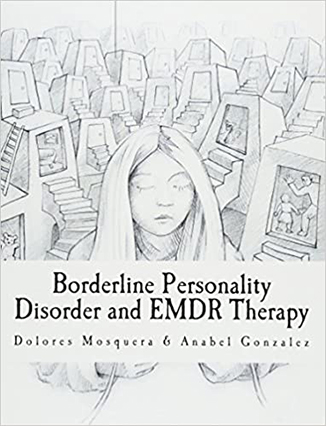
Borderline Personality Disorder and EMDR Therapy
Anabel Gonzalez. Dolores Mosquera
Borderline Personality Disorder and EMDR proposes a comprehensive framework for working with this complex group of clients. The theoretical background integrates attachment theory, structural dissociation, and the adaptive information processing model. Written in a very practical and clinically oriented style, BPD and EMDR covers different situations such as defensive strategies, unhealthy self-care patterns, rigid core beliefs, emotional dysregulation, self-harming behaviors, and relational problems. Therapists should address these issues in order to prepare clients for effective processing of traumatic memories. Working through the different phases of EMDR is described as a therapeutic alternative for borderline clients.
EMDR e disturbo borderline di personalità (Manuali e monografie di psicologia Giunti)
Anabel Gonzalez. Dolores Mosquera
EMDR e disturbo borderline di personalità" è un volume di utilità pratica non solo per i terapeuti con una formazione nel metodo EMDR, ma anche per coloro che lavorano in genere con i disturbi borderline. I pazienti con Disturbo Borderline di Personalità (DBP) costituiscono una popolazione estremamente complessa da trattare. Le sfide che i clinici devono affrontare quando lavorano con tali pazienti sono numerose e il percorso terapeutico può risultare tortuoso, incerto e faticoso. La vasta esperienza clinica delle autrici nel campo del DBP le ha portate a sperimentare in prima persona un gran numero di difficoltà, ma è proprio grazie ad esse che sono arrivate a strutturare un intervento, basato su una profonda conoscenza della metodologia EMDR, come quello descritto nel volume. Gli esempi clinici accompagnati da illustrazioni sono molto utili a comprendere il processo terapeutico.
I disturbi dissociativi. Diagnosi e trattamento
Anabel Gonzalez.
Transtornos Dissociativos: Diagnóstico e Tratamento
Anabel Gonzalez.
Uma análise sobre controverso campo dos transtornos dissociativos, especialmente o Transtorno Dissociativo de Identidade (Múltipla Personalidade). Diferentes teorias sobre o assunto são apresentadas, bem como sua evolução conceitual e histórica. O texto está focado em aspectos clínicos e práticos. Fornecerá ao leitor ferramentas diagnósticas para identificar esses casos, que muitas vezes têm passado desapercebidos. A segunda parte do livro é dedicada à abordagem terapêutica, fornecendo guias gerais para a terapia de transtornos dissociativos, assim como técnicas específicas diretamente aplicáveis. O formato é muito claro e direto, além de estar ilustrado com diversos exemplos e casos clínicos.
Resources

EMO: Emotion regulation interview


PDS (Processing Difficulties Scale)
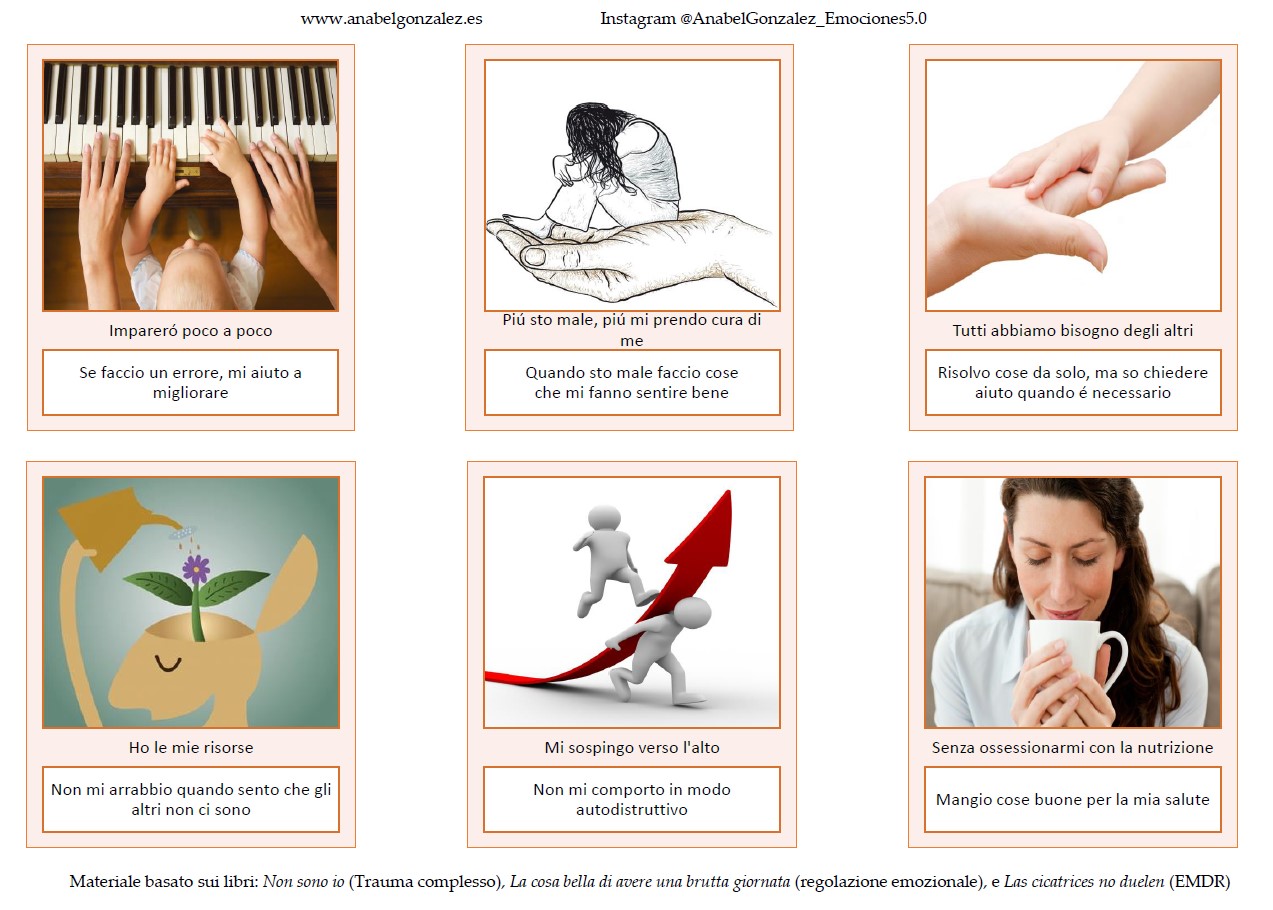
Therapeutic cards · Italiano
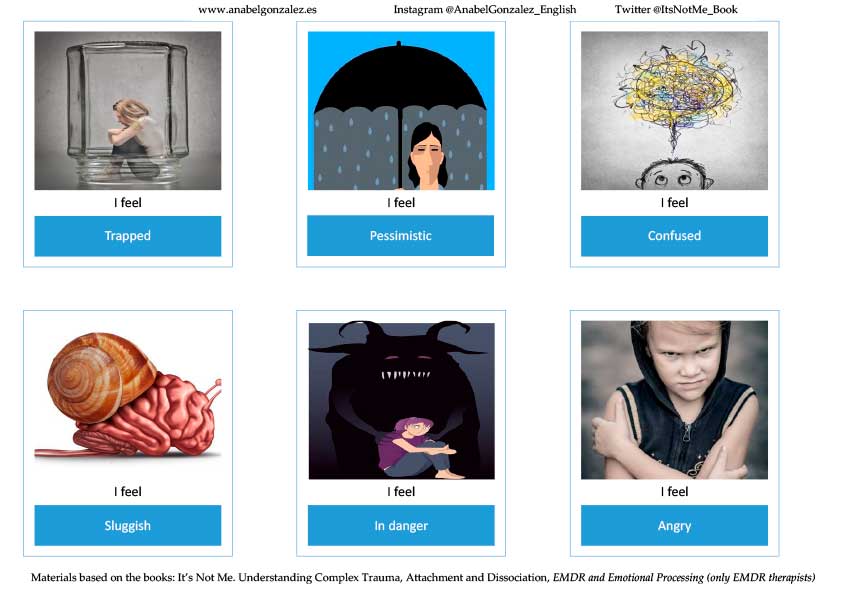
Therapeutic Cards · English
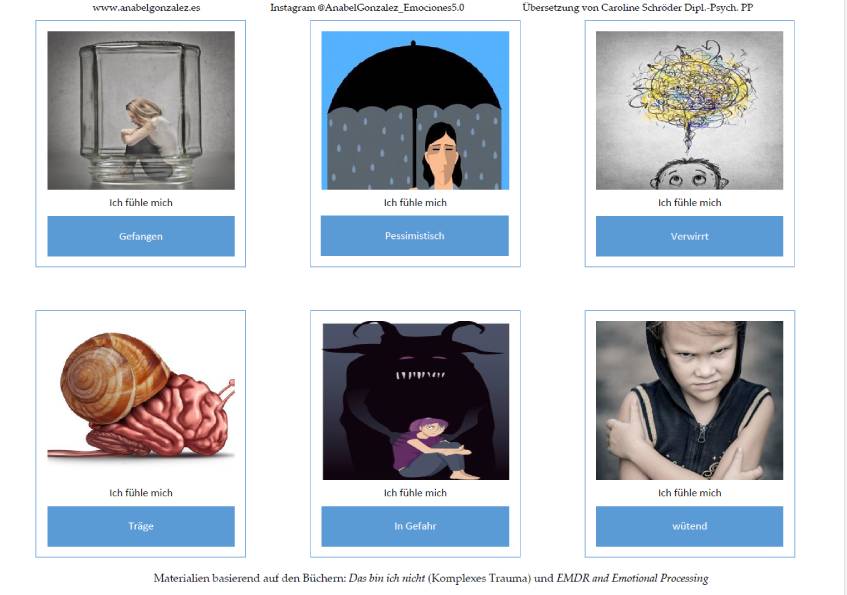
Therapeutic Cards · German
Beschützer Systeme
Emotionale Zustände
Ressourcen
Selbstfürsorge
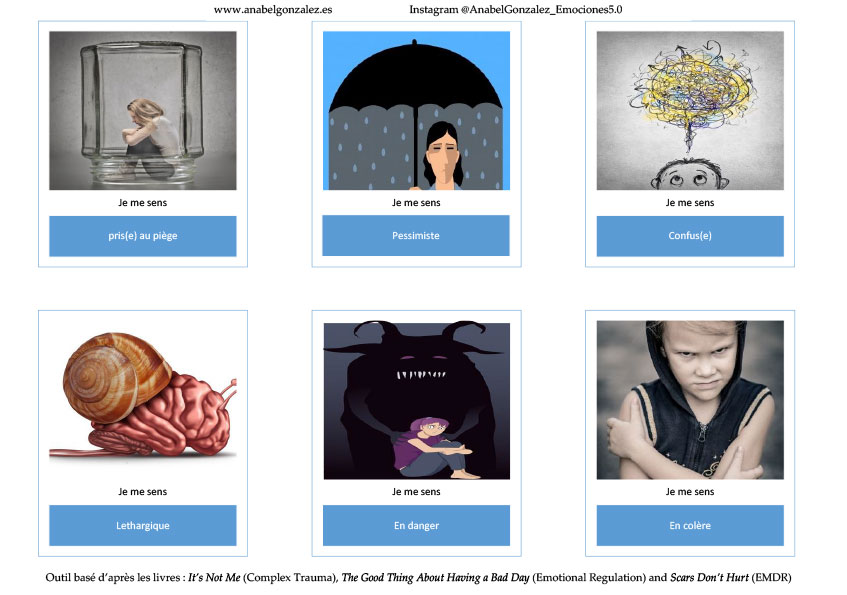
Therapeutic Cards · French
Etats emotionnels
Les ressources
Prendre soin de soi
Systèmes de protection
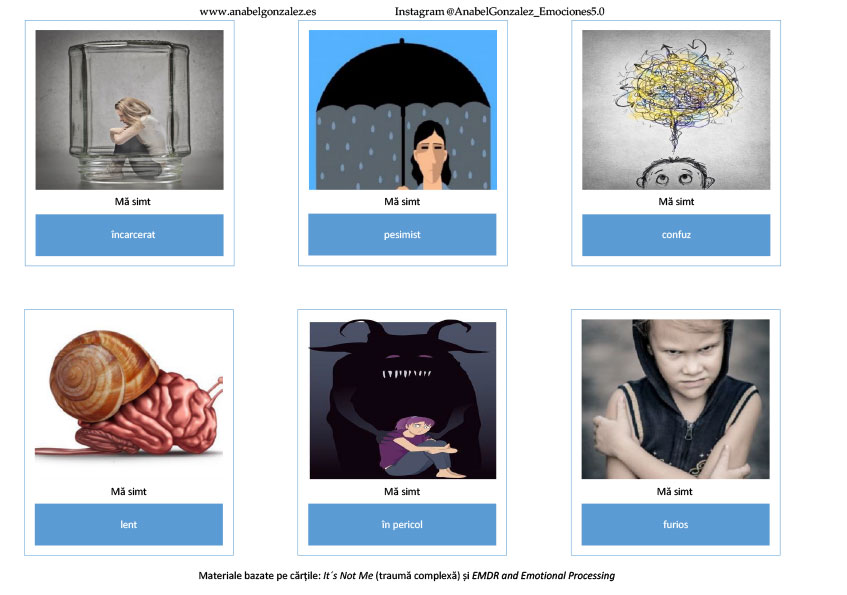
Therapeutic Cards · Romanian
Stari emotionale
Sisteme de protectie
Resurse
Auto-ingrijire
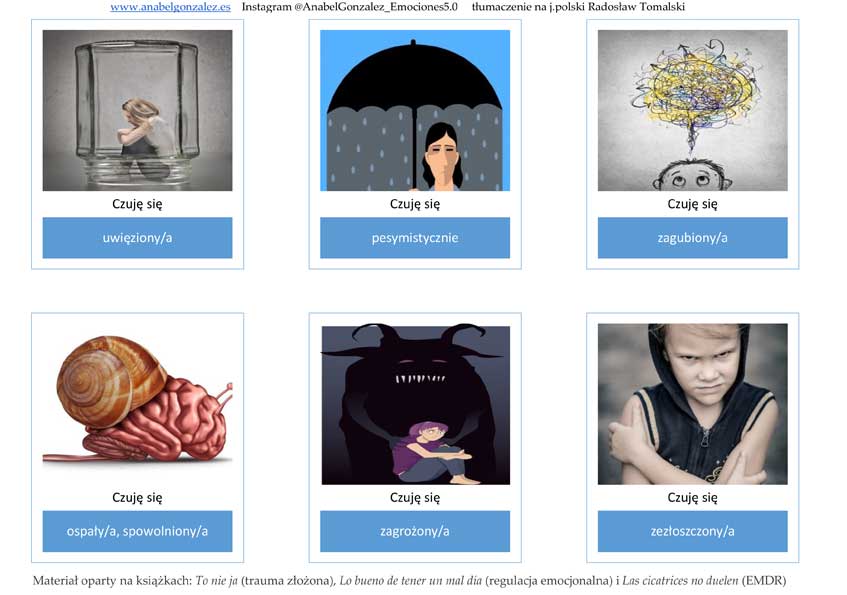
Therapeutic Cards · Polish
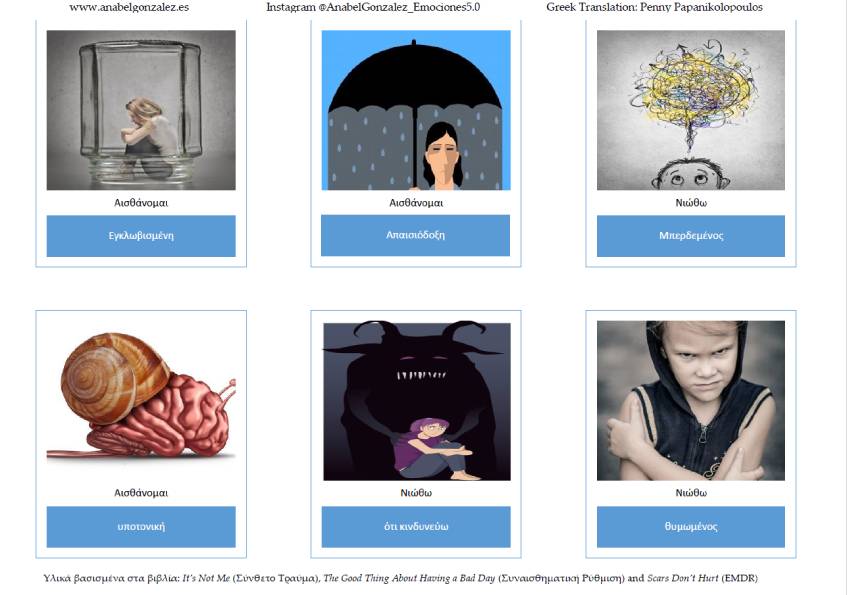
Therapeutic cards · Greek
Συναισθηματικές Καταστάσεις
Συστήματα Προστασίας
Αυτοφροντίδα
Eφόδια / Εφεδρείες
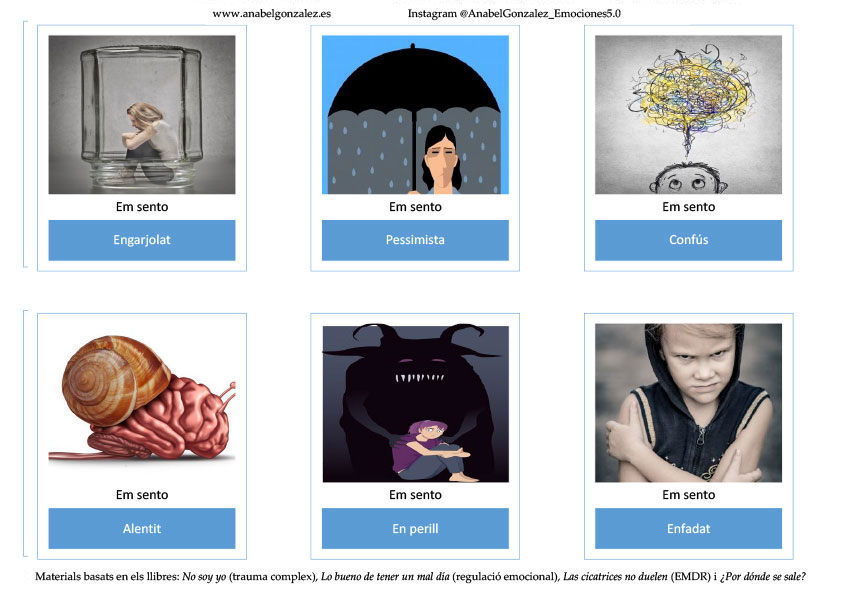
Therapeutic Cards · Catalán
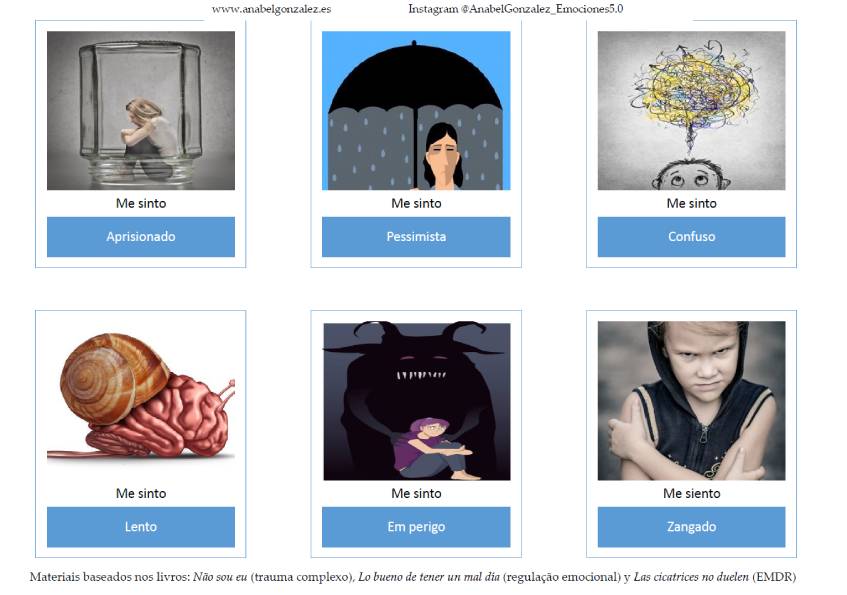
Therapeutic Cards · Portugues
Estados emocionais
Mecanismos de proteção
Recursos
Autocuidado
 @ItsNotMe_Book
 @AnabelGonzalez_English